
Hi! I’m Trang (/tɹaŋ/), a second-year PhD student in the Ecology, Evolution and Behavior program at UT Austin, where I work with Dr. Phuong Dao—one of the greatest supervisors I’ve had.
(Let me try to explain my research without making it sound too complicated), I’m interested in using AI to better understand plants and how they respond to their environments. My current research explores whether vision-language models can distinguish between stress symptoms that look frustratingly similar in remote-sensing images of winter wheat. In other words, I’m teaching AI to become a better plant detective. 🌾🔍
My current CV (updated October 29, 2026):
Warning
Problem: The current name of your GitHub Pages repository ("Solution: Please consider renaming the repository to "
http://".
However, if the current repository name is intended, you can ignore this message by removing "{% include widgets/debug_repo_name.html %}" in index.html.
Action required
Problem: The current root path of this site is "baseurl ("_config.yml.
Solution: Please set the
baseurl in _config.yml to "Education
-
 University of Texas at AustinDepartment of Integrative Biology
Ph.D. StudentJan. 2026 - present -
 Colorado State UniversityDepartment of Agricultural Biology
Ph.D. StudentJan. 2025 - transferred -
 Fulbright University VietnamBSc in Computer Science
Minor: Integrated Sciences (Environmental Science Track)Aug. 2020 - Dec. 2024
Honors & Awards
-
Integrative Biology Graduate Travel Award ($1500)2026
-
TPBank Scholarship for STEM Undergraduate Research ($1500)2023
(Selected) Academic Experience
-
University of Texas at AustinJan. 2026-PresentLab Manager | Graduate Research Assistant | Graduate Teaching Assistant
-
Colorado State UniversityJan. 2025-Dec. 2025Graduate Research Assistant | Graduate Teaching AssistantTeaching courses:
- Plant & Civilization (Fall 2026)
-
Fulbright University VietnamDec. 2021-Dec. 2024Undergraduate Research Assistant & Teaching AssistantTeaching courses:
- Human Genomes & Genomics (Spring 2024)
- Quantitative Reasoning in a Digital Age (Spring 2022)
- Computational Social Media (Fall 2021)
News
Selected Publications (view all )
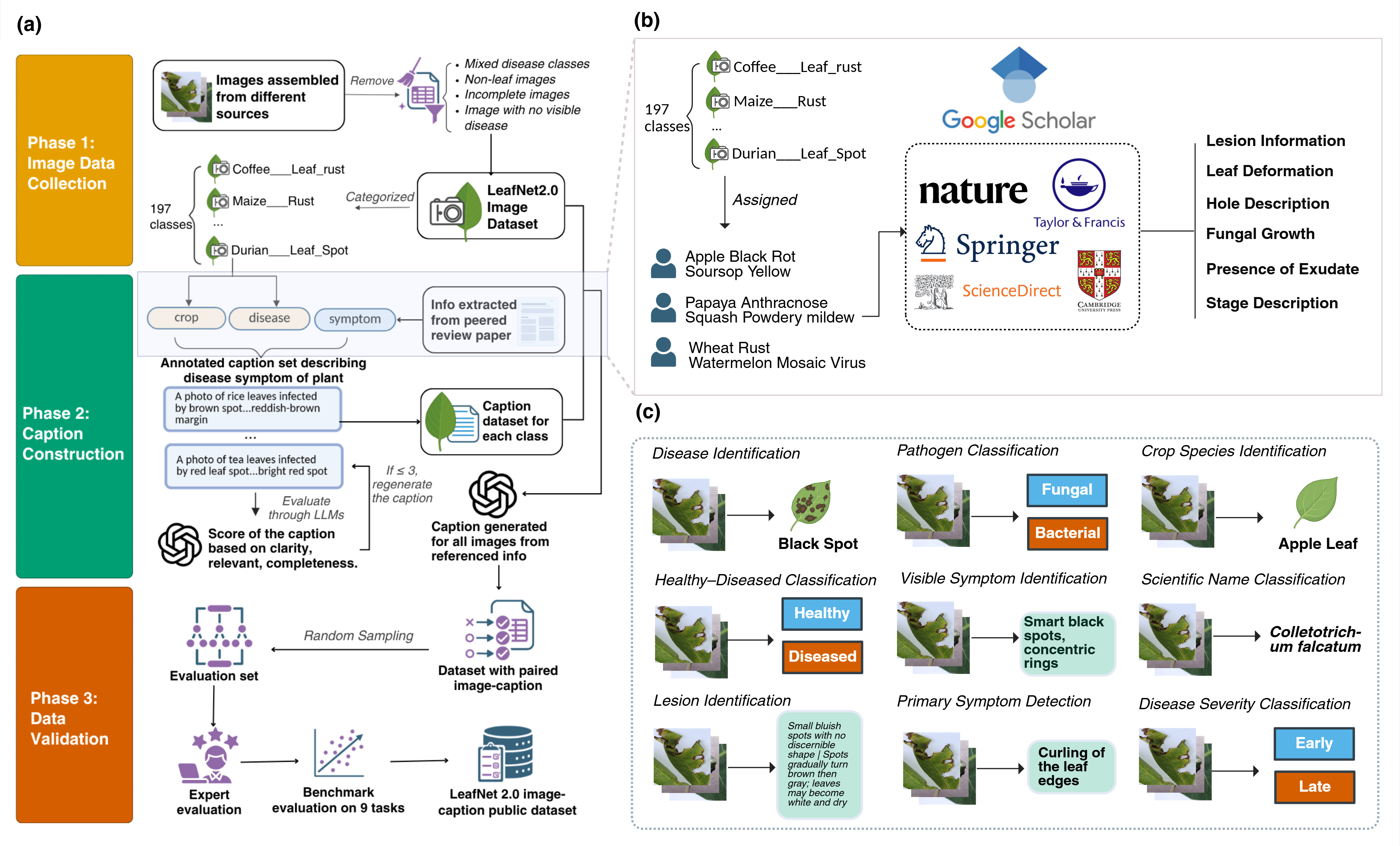
A multiregional image-text dataset and benchmark for vision-language modeling of plant diseases
Trang V. Nguyen*#, Khang Nguyen Quoc*, David Harwath, Luyl-Da Quach, Phuong D. Dao# (* equal contribution, # corresponding author)
Under review. 2026
Plant disease datasets are often fragmented, dominated by controlled-environment imagery, and insufficient for developing transferable AI systems. Here, we present LeafMD, a multimodal resource combining LeafNet 2.0—255,855 image–text pairs spanning 37 crops, 197 crop–disease classes, and nine geographic regions—with LeafBench 2.0, a benchmark evaluating fine-grained pathological reasoning across nine tasks. Evaluation of 16 vision–language models reveals substantial gaps between disease recognition and symptom-level reasoning, highlighting LeafMD’s value for developing disease-aware agricultural foundation models.
All publications
- The name “melanthera-biflora” comes from Melanthera biflora, the scientific name of the sea daisy. Daisy is my English name, while “sea” is a nod to hydrology—the field where my scientific journey began.
- I adopted a cat to help with my anxiety, only to discover that he has anxiety too. Like cat, like owner.
- I love matcha, Sephora, and starting new side projects before finishing the previous ones.